Traveling through Northern India is quite an experience. Even with a modern car and a terrific driver, one still feels as though it's a world apart. Here are a few highlights from the Rajasthan journey:
Monday, January 9, 2012

Monday, November 28, 2011
Jaipur -- Forts, cannon, wall . . . .
After leaving Amber Fort, we proceeded on up the mountain to Jaigarh, a spot famous for one thing: it's the home of the world's largest cannon. Having been built, the cannon was fired only once. They say that the cannon ball went 32 kilometers and created a lake where it landed. The fuse was timed to take 12 seconds to burn its way to the powder. One end was at the cannon and the other end was at a large pond at the foot of the hill. After lighting the fuse, the soldier dove into the lake and waited below the surface of the water for the boom. If he had stayed anywhere else in the area, his eardrums would have been blown out by the force of the blast.


From Jaigarh, we got a good view of the Jaipur Wall. Originally the wall circled the entire city of Jaipur, but Jaipur has sprawled to the point where, from the top of the mountain, it reminds one of Los Angeles, which seems to spread out forever. Much of the 35 kilometers of original wall has fallen into disrepair but is gradually being rebuilt by the government.

Down in Jaipur city proper is beautiful Jaipur Palace. As at all of the places we toured, there was a guide waiting for us. Also, as usual, I lagged behind taking pictures and often annoying our guides, who always seemed to have very definite ideas about how a place should be toured -- usually way too quickly for my eyes and camera. The longer we traveled the more persistent I became about getting the shots I wanted and managed to capture quite a few images from Jaipur Palace.


In the afternoon, we went to Jantar Mantar. That is to say, we went to the Jaipur Jantar Manter; there's also one in Delhi, which we visited 25 years ago. A jantar mantar is a sculptural observatory. Using various parts of it, one can calculate the exact time of day, season of the year, locations of the north star and various constellations, and a number of other astronomical features. From a purely scientific standpoint, they are fascinating, but I find them to be beautiful works of art, as well. I actually had more fun photographing the one in Delhi because we were almost the only people there that morning. Being the only jantar mantar that is still in good working condition, the one in Jaipur is thronged with people. The crush of people and the increasing irritation of our guide at my refusing to pay close attention to all the scientific details he was so carefully spouting made photography a little difficult, but I did manage to get a few shots.
 |
| This sundial is not small. At it's peak, it's probably 20-25 feet tall. There are two of these, one for one half of the year and a second one, which faces in the opposite direction, for the other half of the year. I'm afraid my fatigue was threatening to make me say things I'd later regret, but I managed to just stay quiet. However, my first thought on seeing these two immense structures was that the common sundial we are familiar with in the west, which lies flat on the ground, is not only easier to build but can also be used year round (provided there's sun, of course). |
 |
| You can't really tell from this angle, but this structure is a huge bowl-shaped structure. A person can actually walk in the room below it. If I could remember exactly what it calculated, I'd tell you, but as I've mentioned, I wasn't really paying attention. . . . kind of reminiscent of much of my early childhood. . . . |
But I will share with you what little I know. The maharajahs of the rajput era were all Hindu, so no actual tombs were built to commemorate them as they were for the mughals, since Hindu custom dictates that bodies be cremated after death. The Taj Mahal, for example, is the final resting place of Mumtaz Mahal, the favorite wife of Shah Jahan. Instead, cenotaphs were erected to memorialize the maharajahs. The beautiful cenotaphs below commemorate numerous generations of Jaipur maharajahs.


 |
| A local inhabitant checked us out before hurrying on his way. |
Our exhaustive tour of Jaipur included two more places. This first was Mahdavendra Palace and the final spot was a local carpet and block printing shop. Here are some interior shots of the Mahdavendra Palace. . . . (It can often be quite difficult to get exterior shots of places due to the crush of buildings around them.)


And a couple of parting shots from the fabric and rug shop. . . .
 |
| Block printing on cotton with a hand-carved wooden block. The block is first dipped in the dye, then placed carefully on the fabric, which in this case was printed earlier in a different color, and finally the block is hit on the top with the heel of the hand to set the colors in the fabric. Once the fabric has dried for a day or two in the sun, it is washed with salt water to fix the color. The fixing process also dramatically changes the colors -- in some cases, all the way from red to green or blue. Block printed patterns often consist of four or five different stages of printing -- all done by hand with these small, wooden blocks. |
 |
| The rug weaver at the shop. A hand-knotted rug is like a pointilist painting, with the pattern consisting of tens of thousands of tiny spots of color, each one a scrap of yarn, knotted by hand and then pounded down against its neighbors. Depending on the size of the rug, one rug can take anywhere from a few months to several years to make in this way, so there is a veritable army of cottage industry hand-weavers supplying shops like this one. |
Sunday, November 27, 2011
Jaipur -- Amber Fort and Palace
We spent two days and nights in Jaipur -- two full days of seeing only a part of what's there to be seen and ogled at. When I looked at the number of pictures I'd taken, I realized that Jaipur would have to be divided into sections. I'm starting with the place high on a hill, about 11 kilometers outside of Jaipur -- Amber Fort and Palace.

One of the first things you discover about Amber is that there are two ways to get there: you can either go by elephant or by car. Originally, we were going to ride the elephants up, but looking at the line and realizing that the ride could never ever compare with the amazing elephant ride we had through the Topslip Jungle in south India, we decided to save our money and use the extra hour or so we'd have spent waiting in line to see a little more of the fort and palace. However, I wouldn't want to deprive you of the experience, so here's a small taste. . .

Our driver told us that the elephant rides used to be less crowded, as they were offered all day long. However, a couple of years ago, one of the elephants, tired and cranky after trudging up and down the long ramp for 10 hours or so, went berserk and severely injured a woman. After that, the animal rights activists moved in and said that the fault was not with the elephant, but rather with their working conditions. Thankfully, they won their case and now the rides are only offered between 8 AM and 11 AM each morning.

While each fort or palace in Rajasthan is unique, there is one striking difference about Amber Fort. It combines both Rajput and Mughal (Hindu and Muslim) architecture. Unfortunately, it would take a better-trained eye than mine to be completely sure where one style starts and the other begins, as the fort and palace, which overlook Maota Lake, form a unified whole that is a real feast for the eyes. Here are a few of the sights. . .
 |
| Rajasthan clothing differs from that found in other areas of India in several ways, but perhaps the most striking difference is the abundance of reds, oranges, and the deep saffron yellow like that of the sweeper's sari above. |
 |
| We climbed this staircase up and away from the central courtyard. |
 |
| The simple white of this colonnade was a relaxing contrast to the more ornate parts of the fort. |
 |
| I saw towers similar to this one in all of the rajput forts and palaces we visited. |
 |
| Gate into the palace portion of the fort. |
 |
| A detail of the mosaic on the gate above. |
 |
| While the towers and gate above seem rajput in style, this marble panel is more reminiscent of the panels of the Mughal Taj Mahal in Agra. |
 |
| An audience room for the Maharajah with reclining pillows and hookah, in a setting designed to capture every stray breeze. |
 |
| In a side alleyway of the palace, a group of boys watched a puppet show in which the snake seemed to be getting the best of the snake charmer. |
 |
| And just around the corner -- real snake charmers. |
 |
| These wonderful parasols are to be found only in Rajasthan. |
Having wandered around the fort and palace for the better part of two hours, we found our car and driver and headed off to see a couple of other mountain-top sites. Stay tuned.
Friday, November 25, 2011
Mandawa, Nawalgar, and the Karani Mata Rat Temple
Our next stop was to be Mandawa and then Navalgar, both cities famous for their painted havelis (breeze houses). But first there was a stop not too far from Bikaner -- the Karani Mata Rat Temple. I asked whey it was called the "rat temple" and was just told "you'll see".
 | |
| I took a shot of this sign outside the Rat Temple to demonstrate the Indian attitude toward its beggar problem. Tourists first coming to India are immediately identified and mobbed by beggars, usually small children. The fact is that "beggarship" is usually a family business and, since children can potentially bring in the most money they end up on the streets and don't get the chance to go to school. So the family business goes from one generation to the next. In general, the only places where one now sees beggars in India are around the tourist meccas like the famous palaces, forts, temples, and the five-star hotels. Tourists are encouraged NOT to perpetuate the begging industry and should avoid giving out money in most cases. There are many, many social organizations now in India that take care of the indigent and needy. |
 |
| Front view of the Rat Temple |
 |
| Before I looked down or around me, my eyes went straight to the boy up above, deftly walking on the pigeon netting. |
 |
| And now you know why it's called the Rat Temple. |
According to a local legend, Karni Mata, the 14th century mystic and an incarnation of Hindu goddess Durga, implored Yama, the god of death, to restore the life of the son of one of her storytellers. Yama refused, and Karni Mata incarnated the dead son and all of the storytellers as a rat, under her protection.
 |
| The small rats are everywhere but seem to be content with totally ignoring all of the visitors, which was a relief to my bare feet. |
We left the Rat Temple and continued on toward Mandawa, stopping for lunch at a really lovely place along the way.
 |
| Fountain at the restaurant where we had lunch. |
When we got into Mandawa, one of the first things we both noticed was this sign, which I'm including solely for the benefit of granddaughter Monica. . . .

We found our local guide and began the walking tour of Mandawa. Mandawa and Nawalgar are both famous for their beautifully painted havelis. More and more of the facades are being restored, but I found the original art work to be equally beautiful and fascinating. In general, if the paint on an exterior wall is quite bright and clean looking, it means that it has been restored. Unrestored paintings are severely faded by the sun. Here are a few views. . . .

 |
| The two paintings above are on the facade of the Monica Restaurant and have been nicely restored |


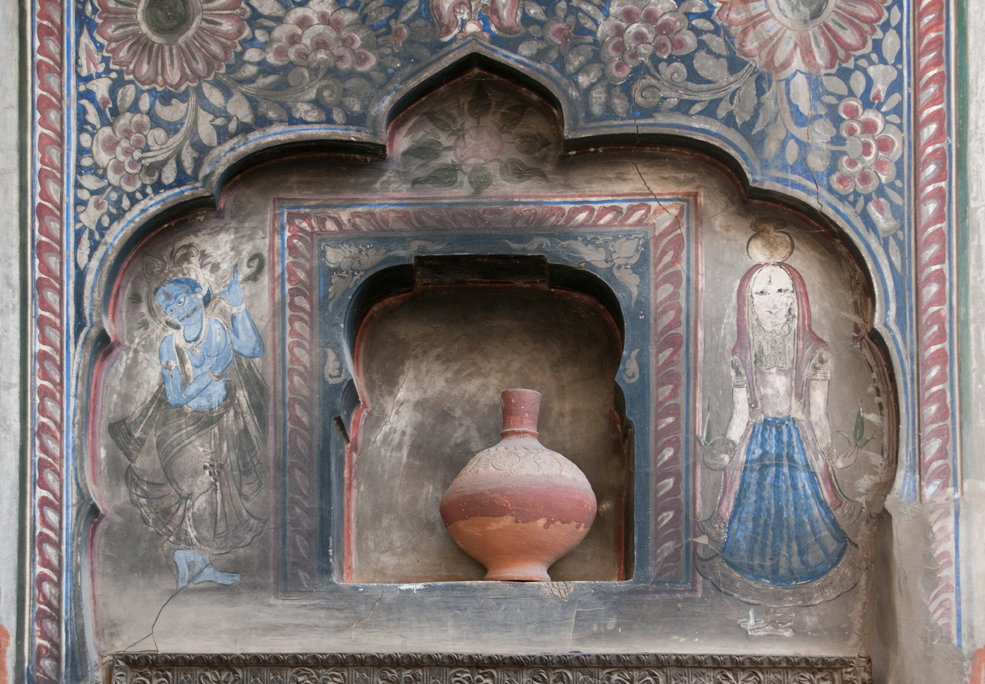 |
| The four images above are examples of paintings that have not been restored. |


 |
| More paintings, in various stages of restoration. |
 |
| Some of the havelis had handicrafts and fabrics for sale. |
 |
| A doorway in Nawalgar. |
That night, we stayed at the Roopniwas Kothi, a restored mansion on the outskirts of Nawalgar. And then, the next day we headed for Jaipur.
Subscribe to:
Posts (Atom)